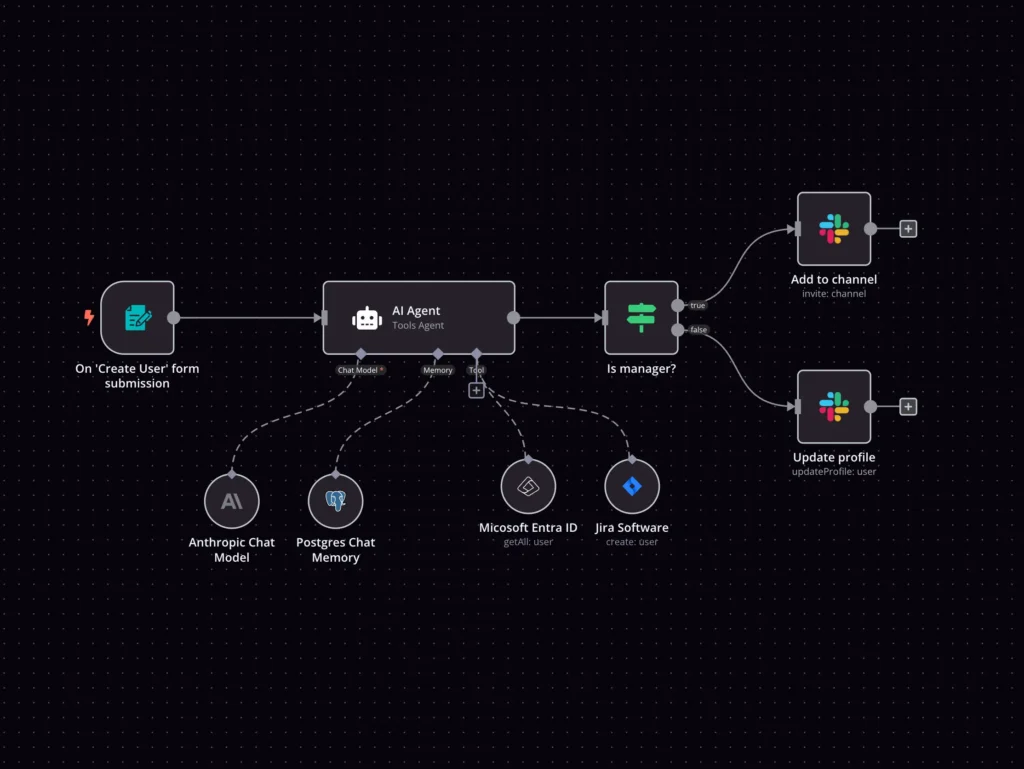
An autonomous AI agent is a program able to execute a business task end to end — read data, decide, act across several tools — without human intervention at every step, under supervision. Unlike a chatbot that answers questions, the agent acts: it opens a ticket, updates a CRM, sends a quote, chases a client.
What is an autonomous AI agent in business? Short answer
An autonomous AI agent combines four building blocks: a language model to reason, connected tools to your systems (ERP, CRM, email, databases), memory to retain context, and guardrails limiting what it can do. It works continuously, logs its actions, and escalates to a human for sensitive decisions.
Chatbot, automation and agent: the real difference
| Type | What it does | Concrete example |
|---|---|---|
| Chatbot | Answers a question | “What is my leave balance?” |
| Automation (workflow) | Runs a fixed rule | If invoice received, record it in the ERP |
| Autonomous AI agent | Decides and acts in a chain | Detects an unpaid invoice, writes the reminder, sends it, updates the CRM, escalates if no reply |
The 4 technical building blocks
1. The model (LLM). The reasoning engine. Cost and quality depend on the chosen model and volume processed.
2. The tools (connectors). The APIs to your systems: ERP, CRM, email, database, files. Without connectors, the agent is useless.
3. Memory. Action history, client context, indexed documents (RAG) so the agent answers from your real data, not generalities.
4. Guardrails. Human validation on sensitive actions, amount limits, complete logging, dedicated encrypted environment.
Realistic use cases for a Moroccan SME
Unpaid invoice chasing: the agent identifies arrears, writes the reminder in the right tone, sends it, tracks replies and escalates.
Inbound lead qualification: form reading, enrichment, scoring, routing to the right salesperson in the CRM.
Supplier research and monitoring: collection, comparison and price synthesis.
Internal document support: answering HR, technical or commercial questions from your indexed procedures. See our digital transformation page.
Risks to contain
A badly governed autonomous agent can act too fast on real data. Main risks: sending an erroneous letter to a client, incorrect writes to the ERP, data leakage, runaway model cost. The answer is systematic: limited action scope, human validation on irreversible actions, spending caps, exhaustive logging and an isolated environment.
What does it cost?
Three cost items: setup (connectors, prompts, guardrails), hosting (dedicated server or cloud), and model consumption (per token processed). For an invoice-chasing or lead-qualification agent, a pilot project is measured in a few weeks, after which the monthly cost scales with the real volume processed — not with the number of users.
In short: an autonomous AI agent acts, it does not just answer. Four blocks: model, connectors, memory, guardrails. The best first project is narrow, measurable and low-risk — such as chasing unpaid invoices.
An agent on your processes?
Devis gratuit sous 24 h. Casablanca et tout le Maroc.